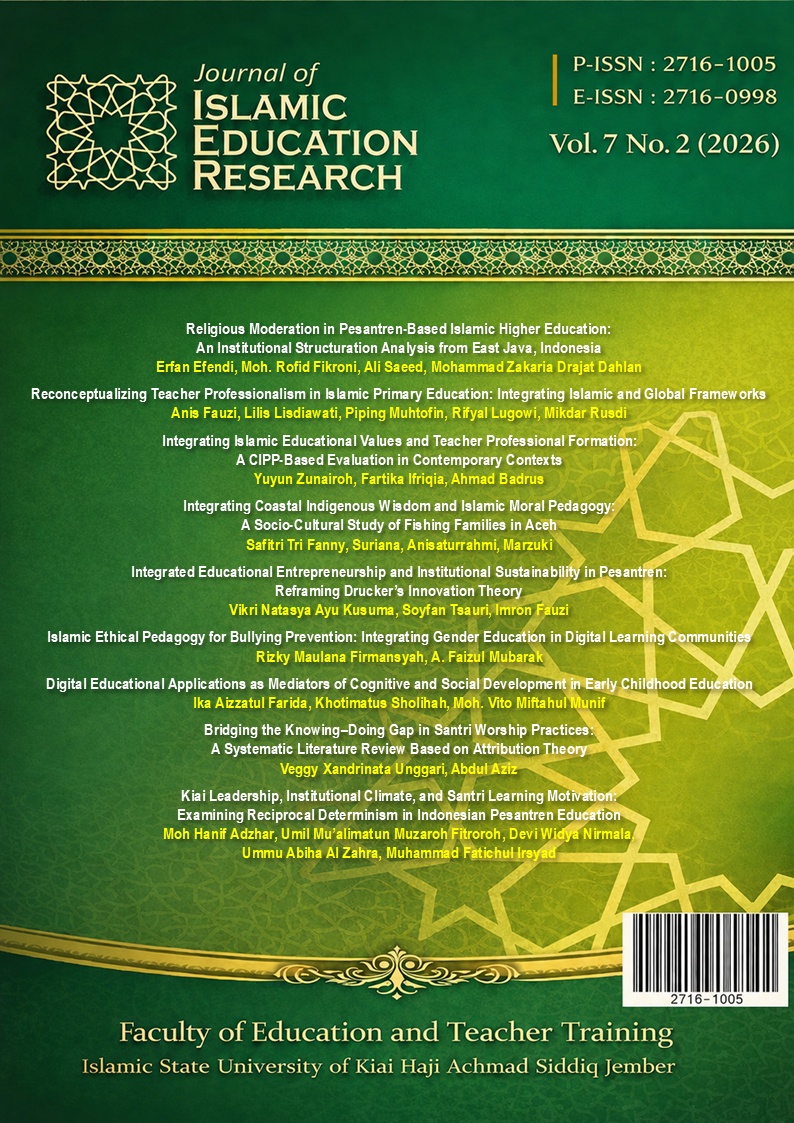
Bridging the Knowing–Doing Gap in Santri Worship Practices: A Systematic Literature Review Based on Attribution Theory
The consistency of worship practices is widely regarded as a key indicator of the success of pesantren education in fostering santri's religious character. However, numerous studies have reported that some santri experience a decline in worship discipline when transitioning from the highly structured pesantren environment to family and community settings characterized by lower levels of supervision and different religious cultures. This phenomenon reflects a knowing–doing gap, in which religious knowledge is not consistently translated into practice. This study aims to examine the theoretical relationships among fiqh al-ibadah understanding, religious motivation, and worship consistency from the perspective of Attribution Theory. The study employed a Systematic Literature Review (SLR) following the PRISMA framework, synthesizing 27 peer-reviewed studies published between 2020 and 2026 retrieved from Scopus, Google Scholar, and SINTA databases. The findings reveal that worship consistency is influenced not only by religious knowledge but also by attributional orientation and motivational processes. Santri who attribute worship to internal factors, such as faith, spiritual awareness, and personal responsibility, are more likely to develop intrinsic religious motivation and maintain worship practices across different social environments. In contrast, external attribution based on institutional regulations, supervision, and social pressure tends to generate controlled motivation and contributes to the persistence of the knowing–doing gap. The novelty of this study lies in the development of an attribution-based framework that integrates an understanding of fiqh al-ibadah, value internalization, attributional orientation, and religious motivation to explain worship consistency among santri. The study contributes to Islamic educational psychology by extending Attribution Theory within pesantren education and providing a conceptual foundation for strengthening sustainable religious character formation.
Downloads
References
Alberto, M. V. J., & Purnomo, H. (2022). Worship as a human motivation in Islamic behaving: Human motivation in behaving. Psikis: Jurnal Psikologi Islami, 8(1), 54–62. https://doi.org/10.19109/psikis.v8i1.11648
Ar Rifni, I. W., Fitriah, E. A., & Nurany, P. N. (2026). Academic motivation of 11th-grade boarding school students: The role of the pesantren climate and self-efficacy. Jurnal Psikologi Islam dan Budaya, 9(1), 27–38. https://doi.org/10.15575/jpib.v9i1.49759
Booth, A., Sutton, A., & Papaioannou, D. (2016). Systematic approaches to a successful literature review (2nd ed.). Sage.
Brambilla, M., Assor, A., Manzi, C., & Regalia, C. (2015). Autonomous versus controlled religiosity: Family and group antecedents. The International Journal for the Psychology of Religion, 25(3), 193–210. https://doi.org/10.1080/10508619.2014.888902
Braun, V., & Clarke, V. (2006). Using thematic analysis in psychology. Qualitative Research in Psychology, 3(2), 77–101. https://doi.org/10.1191/1478088706qp063oa
Hardy, S. A., Nelson, J. M., Frandsen, S. B., Cazzell, A. R., & Goodman, M. A. (2022). Adolescent religious motivation: A self-determination theory approach. The International Journal for the Psychology of Religion, 32(1), 16–30. https://doi.org/10.1080/10508619.2020.1844968
Hidayah, R., Mu'awanah, E., Zamhari, A., Munardji, & Naqiyah. (2021). Learning worship as a way to improve students' discipline, motivation, and achievement at school. Journal of Ethnic and Cultural Studies, 8(3), 292–310. https://doi.org/10.29333/ejecs/748
Hidayat, W., & Hidayat, N. (2024). Character building through exemplification and habitual practices at API ASRI Islamic Boarding School Tegalrejo Magelang. Journal of Islamic Education Management Research, 2(1). https://doi.org/10.14421/jiemr.2024.21-05
Howard, J. L., Gagné, M., Van den Broeck, A., Guay, F., Chatzisarantis, N., Ntoumanis, N., & Pelletier, L. G. (2020). A review and empirical comparison of motivation scoring methods: An application to self-determination theory. Motivation and Emotion, 44(4), 534–548. https://doi.org/10.1007/s11031-020-09831-9
Ilyasin, M., & Muadin, A. (2024). Innovative approach to character education management: Learning integration of systematics nuzulnya wahyu. Al-Hayat: Journal of Islamic Education, 8(1). https://doi.org/10.35723/ajie.v8i1.387
Ishaq, M., & Dayati, U. (2024). Character education through philosophical values in traditional Islamic boarding schools. Kasetsart Journal of Social Sciences, 45(1), 31–42. https://doi.org/10.34044/j.kjss.2024.45.1.04
Kartiko, A., Rofiq, M. H., Fahmi, Q., & Samson, N.-A. T. (2026). Character education from the perspective of Islamic boarding school (pesantren): An implementative study. Fikroh: Jurnal Pemikiran dan Pendidikan Islam, 19(1), 70–84. https://doi.org/10.37812/fikroh.v19i1.1790
Kibtiyah, A. (2026). Value internalization and character development of santri: A systematic literature review from an educational psychology perspective. Journal of Islamic Education and Pesantren, 5(1), 22–33. https://doi.org/10.33752/jiep.v5i1.11321
Kitchenham, B., & Charters, S. (2007). Guidelines for performing systematic literature reviews in software engineering. EBSE Technical Report, Durham University.
Komalasari, M., & Yakubu, A. B. (2023). Implementation of student character formation through Islamic religious education. At-Tadzkir: Islamic Education Journal, 2(1), 52–64. https://doi.org/10.59373/attadzkir.v2i1.16
Kusuma, F. A., Nurhayati, & Susilo. (2021). Penguatan pendidikan karakter peserta didik melalui peraturan pondok pesantren di era 4.0. Jurnal Ilmiah Mimbar Demokrasi, 21(1). https://doi.org/10.21009/jimd.v21i1.23046
Lahmar, F. (2020). Islamic education: An Islamic wisdom-based cultural environment in a Western context. Religions, 11(8), Article 409. https://doi.org/10.3390/rel11080409
Mashuri, S., Futaqi, S., & Sulhan, A. (2024). Spiritual base of pesantren for building multicultural awareness in Indonesia context. Jurnal Ilmiah Islam Futura, 24(1), 1–20. https://doi.org/10.22373/jiif.v24i1.17141
Maulina, R., Dhewanto, W., Faturohman, T., & Dellyana, D. (2026). What motivates waqf-based (Islamic endowment) entrepreneurs in creating sustainable welfare? An empirical investigation in Indonesia. Journal of Islamic Accounting and Business Research. Advance online publication. https://doi.org/10.1108/JIABR-11-2023-0383
Miftahuddin, M., Aman, A., & Yuliantri, R. D. A. (2024). Islamic character education model: An in-depth analysis for Islamic boarding school. Jurnal Cakrawala Pendidikan, 43(2), 370–380. https://doi.org/10.21831/cp.v43i2.66516
Mujahid, I. (2021). Islamic orthodoxy-based character education: Creating moderate Muslims in a modern pesantren in Indonesia. Indonesian Journal of Islam and Muslim Societies, 11(2), 185–212. https://doi.org/10.18326/ijims.v11i2.185-212
Muttaqin, A. I., Wardah, Z., & Syafi’i, I. (2023). Formation of learning motivation in Islamic religious education through Ceramah Plus method and spiritual activities. Journal of Islamic Education Research, 4(2), 177–192. https://doi.org/10.35719/jier.v4i2.340
Naqiba, M. I., & Taqiyyuddin, Y. M. (2025). Research trends on Islamic education learning intensity and students’ religiosity: Implications of democracy in education. Multicultural Islamic Education Review, 3(2), 199–214. https://doi.org/10.23917/mier.v3i2.12485
Nasution, N., & Nafi, S. B. A. (2026). Culture-based religious character formation in Islamic secondary education: A case study of MAS Al-Washliyah Tembung. International Journal of Islamic Education, Research and Multiculturalism (IJIERM), 8(2), 720–743.
Nisa, M., Shobihah, S. S., Firmansyah, M. I., Fakhruddin, A., & Anwar, S. (2024). An affective domain evaluation in Islamic education: A perspective from self-determination theory. Progresiva: Jurnal Pemikiran dan Pendidikan Islam, 13(1), 101–114. https://doi.org/10.22219/progresiva.v13i01.31509
Nurtawab, E., & Wahyudi, D. (2022). Restructuring traditional Islamic education in Indonesia: Challenges for pesantren institution. Studia Islamika, 29(1), 55–81. https://doi.org/10.36712/sdi.v29i1.17414
Ok, A. H., Oviyanti, F., Niswah, C., Arsyad, J., & Nuraeni, H. A. (2026). A narrative case study: Parental views on the enactment of character education in Islamic boarding schools. Journal of Moral Education. Advance online publication. https://doi.org/10.1080/03057240.2026.2660726
Osman, Y. (2026). Understanding how to develop an effective role-modelling character education programme in Saudi Arabia. Globalisation, Societies and Education, 24(2), 447–462. https://doi.org/10.1080/14767724.2024.2330363
Page, M. J., McKenzie, J. E., Bossuyt, P. M., Boutron, I., Hoffmann, T. C., Mulrow, C. D., Shamseer, L., Tetzlaff, J. M., Akl, E. A., Brennan, S. E., Chou, R., Glanville, J., Grimshaw, J. M., Hróbjartsson, A., Lalu, M. M., Li, T., Loder, E. W., Mayo-Wilson, E., McDonald, S., ... Moher, D. (2021). The PRISMA 2020 statement: An updated guideline for reporting systematic reviews. BMJ, 372, n71. https://doi.org/10.1136/bmj.n71
Prihatin, N. Y., Ferianto, F., & Ilhami, M. W. (2023). Peranan pembelajaran pendidikan agama Islam dalam memotivasi peserta didik guna meningkatkan aktivitas ibadah. Muaddib: Islamic Education Journal, 6(2), 88–94. https://doi.org/10.19109/muaddib.v6i2.22170
Riduansyah, A., Aslamiah, & Saleh, M. (2026). Analysis of character education management at modern Islamic boarding schools. Curricula: Journal of Curriculum Development, 5(1). https://doi.org/10.17509/curricula.v5i1.211
Rofiqi, Zainiyati, H. S., Niam, K., & Kusaeri. (2026). Living under the gaze: An ethnographic study of authority, embodied learning, and social reproduction in Indonesian pesantren educational practices. Ethnography and Education. Advance online publication. https://doi.org/10.1080/17457823.2026.2614516
Rostiani, R., Toyib, J. S., & Khoiriyah, S. (2021). Why do Muslims engage in adaptive worship behavior during the pandemic? The role of protection motives and religiosity. Journal of Islamic Marketing, 12(3), 518–542. https://doi.org/10.1108/JIMA-09-2020-0261
Rozikin, M. C., & Astutik, A. P. (2021). Implementation of character education in Islamic boarding schools: Implementasi pendidikan karakter di pondok pesantren. Academia Open, 4, Article 2544. https://doi.org/10.21070/acopen.4.2021.2544
Rusmana, D., Rosidin, D. N., Saefullah, A., Burhanudin, D., & Zainuddin, G. B. (2024). Strengthening moral education values: Sociological analysis of the Mbah Sholeh Haolan at Pesantren Benda Kerep, Cirebon. Ulumuna, 28(1), 424–452. https://doi.org/10.20414/ujis.v28i1.1050
Ryan, R. M., & Deci, E. L. (2000). Self-determination theory and the facilitation of intrinsic motivation, social development, and well-being. American Psychologist, 55(1), 68–78. https://doi.org/10.1037/0003-066X.55.1.68
Ryan, R. M., & Deci, E. L. (2020). Intrinsic and extrinsic motivation from a self-determination theory perspective: Definitions, theory, practices, and future directions. Contemporary Educational Psychology, 61, Article 101860. https://doi.org/10.1016/j.cedpsych.2020.101860
Saleh, M. (2024). The pattern of education on aqidah, worship, and morals of the santri at Tassbeh Baitul Qur'an Islamic Boarding School, Pinrang Regency. International Journal of Health, Economics, and Social Sciences (IJHESS), 6(2), 288–300.
Saparwadi. (2023). Pondok pesantren sebagai penguatan pendidikan karakter: Tinjauan filsafat pendidikan Islam. Al-Jadwa: Jurnal Studi Islam, 3(2). https://doi.org/10.38073/aljadwa.v3i2.1771
Sayfo, O. (2026). Toward an exceptional Qurʾanic generation: How Dar al-Wahy al-Sharif schools shape Islam, identity, and power in Northwest Syria. International Journal of Middle East Studies. Advance online publication. https://doi.org/10.1017/S0020743825101372
Sayuti, L., Burhanudin, N., Yaqin, L. N., & Famuji, U. (2026). Developing a local wisdom-based “Patju” religious culture model to improve students' worship practices in Islamic senior high schools. Al-Tadzkiyyah: Jurnal Pendidikan Islam, 17(2), 295–314. https://doi.org/10.24042/atjpi.v17i2.30465
Snyder, H. (2019). Literature review as a research methodology: An overview and guidelines. Journal of Business Research, 104, 333–339. https://doi.org/10.1016/j.jbusres.2019.07.039
Sopandi, I., Sumantri, S., Saefurridjal, A., & Helmawati. (2025). An integrated approach to character education in Islamic boarding schools. Islamic Management: Jurnal Manajemen Pendidikan Islam, 8(1). https://doi.org/10.30868/im.v8i01.8027
Spilka, B., Shaver, P., & Kirkpatrick, L. A. (1985). A general attribution theory for the psychology of religion. Journal for the Scientific Study of Religion, 24(1), 1–20. https://doi.org/10.2307/1386272
Supriyandi, R., Chandra, P., & Marhayati, N. (2025). Teachers' strategies in instilling religious and disciplinary character values. Jurnal Pendidikan Islam, 15(2), 196–209. https://doi.org/10.38073/jpi.v15i2.3379
Tranfield, D., Denyer, D., & Smart, P. (2003). Towards a methodology for developing evidence-informed management knowledge by means of systematic review. British Journal of Management, 14(3), 207–222. https://doi.org/10.1111/1467-8551.00375
Walter, Y., & Altorfer, A. (2022). The psychological role of music and attentional control for religious experiences in worship. Quarterly Journal of Experimental Psychology, 75(12), 2272–2286. https://doi.org/10.1177/17470218221075330
Weiner, B. (1972). Attribution theory, achievement motivation, and the educational process. Review of Educational Research, 42(2), 203–215. https://doi.org/10.3102/00346543042002203
Xiao, Y., & Watson, M. (2019). Guidance on conducting a systematic literature review. Journal of Planning Education and Research, 39(1), 93–112. https://doi.org/10.1177/0739456X17723971
Yulistiawati, D., Komariah, A., Suryana, A., & Aedi, N. (2025). Trends in heutagogy research on Islamic education (2010–2024): A bibliometric study from Scopus. Conciencia, 25(2), 259–270. https://doi.org/10.19109/89qgyk62
Yusuf, M., Alwis, A., Putra, E., Witro, D., & Nurjaman, A. (2023). The role of Anak Jalanan At-Tamur Islamic Boarding School in internalizing the values of religious moderation to college students in Bandung. Jurnal Ilmiah Islam Futura, 23(1), 132–156. https://doi.org/10.22373/jiif.v23i1.15358
Zahrah, R., Lubis, L., & Sitorus, M. (2025). Islamic guidance and counseling practices for strengthening student adjustment: A multisite study in urban modern pesantren of Medan. Jurnal Pendidikan Islam, 14(2), 209–224. https://doi.org/10.14421/jpi.2025.142.209-224
Downloads
Section
Copyright (c) 2026 Veggy Xandrinata Unggari, Abdul Aziz

This work is licensed under a Creative Commons Attribution-ShareAlike 4.0 International License.