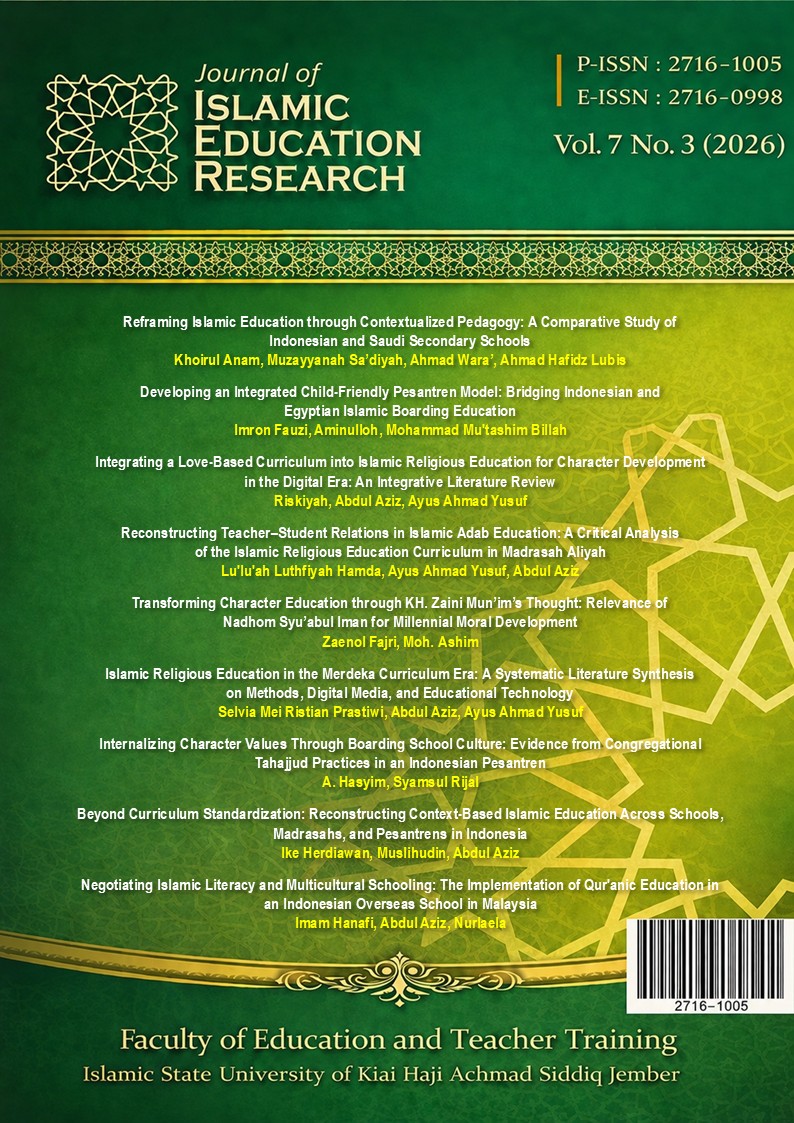
Reconstructing Teacher–Student Relations in Islamic Adab Education: A Critical Analysis of the Islamic Religious Education Curriculum in Madrasah Aliyah
This study aims to reconstruct teacher–student relations in Islamic adab education by critically examining the construction of authority, obedience, and student positioning within the Islamic Religious Education curriculum of Madrasah Aliyah. The study employed a qualitative library research design integrating thematic synthesis, critical textual analysis, Jacques Derrida’s deconstruction, and Michel Foucault’s theory of power relations. Data were collected from PAI curriculum documents, adab-related learning materials, classical Islamic educational texts, and relevant Scopus-indexed literature. The findings reveal three interconnected themes: teacher authority remains a fundamental element of Islamic adab education, student agency is increasingly recognized as an essential dimension of meaningful learning, and safe learning environments require a balance between ethical authority, learner participation, and educational accountability. The study further demonstrates that hierarchical interpretations of authority and obedience can be reinterpreted through a dialogical-adab framework that promotes mutual respect, learner dignity, and educational responsibility. The novelty of this study lies in integrating Islamic adab traditions, student agency theory, educational safeguarding, and critical perspectives on power relations into a unified framework for curriculum reconstruction. The study contributes to Islamic educational theory and curriculum development by offering a dialogical-adab model that supports ethical leadership, student empowerment, and safe learning environments in contemporary Islamic education.
Downloads
References
Abdalla, M. (2025). Exploring tarbiyah in Islamic education: A critical review of the English- and Arabic-language literature. Education Sciences, 15(5). https://doi.org/10.3390/educsci15050559
Adhikari, D. P. (2024). Constructing student agency: The nexus between classroom activities and engagement. International Journal of Education and Practice, 12(3), 819–830. https://doi.org/10.18488/61.v12i3.3759
Al-Attas, S. M. N. (1980). The Concept of Education in Islam: A Framework for an Islamic Philosophy of Education. Kuala Lumpur: ABIM.
Bowen, G. A. (2009). Document analysis as a qualitative research method. Qualitative Research Journal, 9(2), 27–40. https://doi.org/10.3316/QRJ0902027
Braun, V., & Clarke, V. (2022). Thematic analysis: A practical guide. SAGE.
Bruce, B. C. (2025). Creative democracy: How democratic education can restore and enrich democracy. Education and Culture, 41(1), 31–61. https://doi.org/10.7771/1559-1786.1932
D’Olimpio, L. (2024). The limits to dialogue. Oxford Review of Education, 50(5), 626–640. https://doi.org/10.1080/03054985.2023.2268513
Daud, W. M. N. W. (1998). The Educational Philosophy and Practice of Syed Muhammad Naquib al-Attas: An Exposition of the Original Concept of Islamization. Kuala Lumpur: International Institute of Islamic Thought and Civilization.
Derrida, J. (1997). Of grammatology. Johns Hopkins University Press.
Feichtinger, C., & Yagdi, S. (2020). Virtue ethics in Christian-Islamic religious education: Towards an inter-religious ethical education. Österreichisches Religionspädagogisches Forum, 28(1), 251–272. https://doi.org/10.25364/10.28:2020.1.14
Ferrada, D., Briones, A. S., & Espinoza, C. J. (2023). The transformation of the curriculum in the Linking Worlds Dialogic Pedagogy. Dialogic Pedagogy, 11(1), A108–A128. https://doi.org/10.5195/dpj.2023.536
Foucault, M. (1980). Power/knowledge: Selected interviews and other writings 1972–1977. Pantheon Books.
Franken, L., & Gent, B. (2021). Islamic religious education in Europe: A comparative study. Routledge. https://doi.org/10.4324/9780429331039
Hooshyar, D., Tammets, K., Ley, T., Aus, K., & Kollom, K. (2023). Learning analytics in supporting student agency: A systematic review. Sustainability, 15(18). https://doi.org/10.3390/su151813662
Huda, M., Yusuf, J. B., Jasmi, K. A., & Zakaria, G. N. (2016). Al-Zarnūjī’s concept of knowledge (‘ilm). SAGE Open, 6(3). https://doi.org/10.1177/2158244016666885
In’Ami, M., Bambang, & Wekke, I. S. (2025). Contextualising adab in Islamic education from the perspective of Al-Attas. Journal of Al-Tamaddun, 20(1), 145–158. https://doi.org/10.22452/JAT.vol20no1.11
Ismail, A. M., Mujani, W. K., Rahman, Z. A., & Salahuddin, N. F. (2018). Maqasid syariah and safety aspects in infrastructure and health of education practices in Malaysia. International Journal of Civil Engineering and Technology, 9(10), 820–830.
Ismail, S., Sabri, H., Asari, H., Yamin, M., & Yunus, M. M. (2024). Fostering emotional and moral development in Islamic boarding schools: The impact of talaqqî and ḥalaqa traditions. Jurnal Pendidikan Islam, 10(1), 13–24. https://doi.org/10.15575/jpi.v0i0.35124
Kim, M. (2022). Student agency and teacher authority in inquiry-based classrooms: Cases of elementary teachers’ classroom talk. International Journal of Science and Mathematics Education, 20(8), 1927–1948. https://doi.org/10.1007/s10763-021-10233-7
Klemenčič, M. (2023). A theory of student agency in higher education. In Research Handbook on the Student Experience in Higher Education (pp. 25–40). Edward Elgar Publishing. https://doi.org/10.4337/9781802204193.00010
Leo, A., Wilcox, K. C., Kramer, C., Lawson, H. A., & Min, M. (2020). Teacher and student reciprocal agency in odds-beating schools. Teachers College Record, 122(12). https://doi.org/10.1177/016146812012201212
Malik, S., & Jumani, N. B. (2022). Islamic instruction as a student-centred approach. In Supporting Modern Teaching in Islamic Schools: Pedagogical Best Practice for Teachers (pp. 57–67). Routledge. https://doi.org/10.4324/9781003193432-6
Mitkees, S., & El Odessy, D. (2025). The facilitator as murabi: Exploring the teacher–student relationship in light of a holistic learner experience framework in an Islamic university in Egypt. Journal of Education in Muslim Societies, 7(1), 51–75. https://doi.org/10.2979/jems.00041
Noaparast, K. B. (2012). Al-Attas revisited on the Islamic understanding of education. Journal of Shi’a Islamic Studies, 5(2), 149–172. https://doi.org/10.1353/isl.2012.0010
Riddle, S. (2022). Democracy and education. In International Encyclopedia of Education (4th ed., pp. 8–12). Elsevier. https://doi.org/10.1016/B978-0-12-818630-5.08002-7
Saihu, M., Umar, N., Raya, A. T., & Shunhaji, A. (2022). Multicultural education based on religiosity to enhance social harmonization within students. Pegem Egitim ve Ogretim Dergisi, 12(3), 265–274. https://doi.org/10.47750/pegegog.12.03.28
Scanlon, D., & Connolly, C. (2021). Teacher agency and learner agency in teaching and learning a new school subject. Computers & Education, 174. https://doi.org/10.1016/j.compedu.2021.104291
Scott, J. (2014). A matter of record: Documentary sources in social research. Polity Press.
Succarie, A. (2024). Examining the implications of Islamic teacher education and professional learning: Towards professional identity renewal in Islamic schools. Education Sciences, 14(11). https://doi.org/10.3390/educsci14111192
Suhayib, & Ansyari, M. (2023). Design of Islamic religious education: Purposes, alignment of curriculum components and contexts. British Journal of Religious Education, 45(4), 382–393. https://doi.org/10.1080/01416200.2023.2220940
Tamuri, A. H., Ismail, M. F., & Jasmi, K. A. (2012). Basic components for Islamic education teacher training. Global Journal Al-Thaqafah, 2(2), 53–63.
Waghid, Y. (2009). Islamic education. In International Encyclopedia of Education (3rd ed., pp. 69–73). Elsevier. https://doi.org/10.1016/B978-0-08-044894-7.00561-3
Zul, Z., Huda, M. N., Fuad, Z., & Abdullah, M. (2026). Integration of Islamic ethics in modern education curriculum: Challenges and opportunities—A systematic literature review. British Journal of Religious Education. https://doi.org/10.1080/01416200.2026.2621177
Downloads
Section
Copyright (c) 2026 Lu'lu'ah Luthfiyah Hamda, Ayus Ahmad Yusuf, Abdul Aziz

This work is licensed under a Creative Commons Attribution-ShareAlike 4.0 International License.