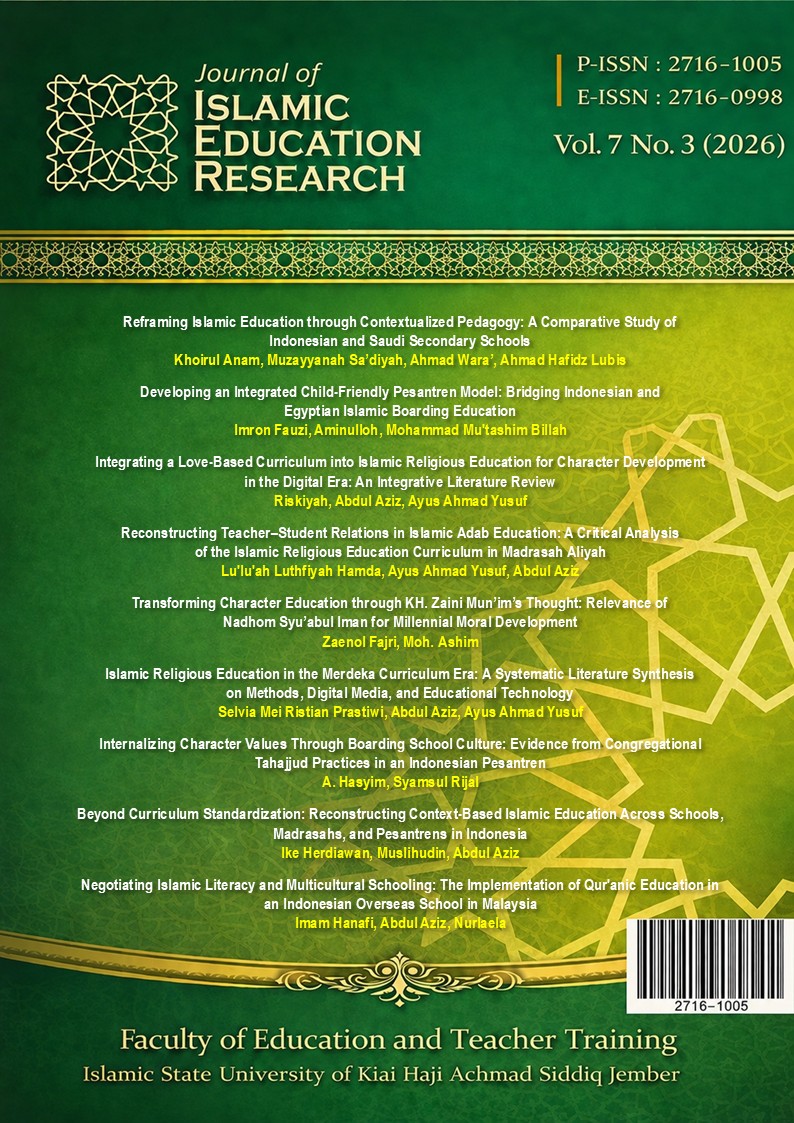
Beyond Curriculum Standardization: Reconstructing Context-Based Islamic Education Across Schools, Madrasahs, and Pesantrens in Indonesia
This study reconstructs Islamic Religious Education beyond curriculum standardization by proposing a context-based framework applicable across schools, madrasahs, and pesantrens in Indonesia. It responds to the need for Islamic education to address socio-cultural diversity, technological transformation, local needs, and contemporary educational challenges while maintaining its Islamic foundations. Using a qualitative library research design, the study employed a critical-integrative review approach. Data were collected from 72 selected publications indexed in Scopus and other reputable academic databases and analyzed through thematic, comparative, and critical synthesis techniques. The findings indicate that curriculum contextualization functions as a transformative paradigm rather than merely a pedagogical strategy. Schools emphasize differentiated instruction and project-based learning, madrasahs integrate national and religious curricula while promoting religious moderation, and pesantrens adopt selective modernization while preserving Islamic traditions. Across these institutions, contextualization enhances curriculum relevance, learner engagement, digital adaptability, and character development. The study's novelty lies in the Context-Based Islamic Education Curriculum (CBIEC) framework, which integrates Islamic foundations, contextual realities, adaptive pedagogies, and future-oriented competencies. The study contributes to curriculum theory by demonstrating how contextualization can reconcile religious authenticity, institutional diversity, and contemporary educational demands.
Downloads
References
Ahmad, Z. A., & Soeparwati. (2026). Transformative Islamic education in conflict-prone plural societies: A holistic pedagogical model from Papua, Indonesia. British Journal of Religious Education. Advance online publication. https://doi.org/10.1080/01416200.2026.2690036
Amalia, E. R., Dwi Bhakti Indri, M., Khoiriyati, S., Ummah, N., Oviani, M., Wardhani, J. K., & Umayyah, U. (2024). Bridging educational reform and faith: Evaluating Kurikulum Merdeka's compatibility with Islamic values in madrasahs. Munaddhomah, 5(4), 483–500. https://doi.org/10.31538/munaddhomah.v5i4.1413
Amalia, E. R., Dwi Bhakti Indri, M., Khoiriyati, S., Ummah, N., Oviani, M., Wardhani, J. K., & Umayyah, U. (2024). Bridging educational reform and faith: Evaluating Kurikulum Merdeka's compatibility with Islamic values in madrasahs. Munaddhomah, 5(4), 483–500. https://doi.org/10.31538/munaddhomah.v5i4.1413
Anwar, L., Sa'Dijah, C., Hidayah, I. R., & Abdullah, A. H. (2024). Integrating local wisdom and project-based learning to enhance critical thinking, collaboration, and creativity in mathematics education. AIP Conference Proceedings, 3148(1), 040032. https://doi.org/10.1063/5.0241446
Basori, R., Raharjo, T. J., Prihatin, T., & Yulianto, A. (2023). Maintaining Salafi values through innovative management practices at pesantren. Jurnal Pendidikan Islam, 9(2), 145–156. https://doi.org/10.15575/jpi.v9i2.25376
Braun, V., & Clarke, V. (2006). Using thematic analysis in psychology. Qualitative Research in Psychology, 3(2), 77–101. https://doi.org/10.1191/1478088706qp063oa
Case, J. M., Fraser, D. M., Kumar, A., & Itika, A. (2016). The significance of context for curriculum development in engineering education: A case study across three African countries. European Journal of Engineering Education, 41(3), 279–292. https://doi.org/10.1080/03043797.2015.1056103
Case, J. M., Fraser, D. M., Kumar, A., & Itika, A. (2016). The significance of context for curriculum development in engineering education: A case study across three African countries. European Journal of Engineering Education, 41(3), 279–292. https://doi.org/10.1080/03043797.2015.1056103
Costa, H. H. C., & Lopes, A. C. (2018). Contextualization of knowledge in high school: Attempts to control the other. Educação & Sociedade, 39(143), 301–320. https://doi.org/10.1590/es0101-73302018184558
DelaTorre-Diaz, L., Ramírez-Pérez, H. X., & Escobar-Castillejos, D. (2025). The effectiveness of curriculum standardization in data analysis and tools proficiency for undergraduate education: A case study. Frontiers in Education, 10, 1537174. https://doi.org/10.3389/feduc.2025.1537174
Estaiteyeh, M., DeCoito, I., & Takkouch, M. (2024). STEM teacher candidates’ preparation for online teaching: Promoting technological and pedagogical knowledge. Canadian Journal of Learning and Technology, 50(4), 1–20. https://doi.org/10.21432/cjlt28594
Fitriani, E., Fatimatur Rusydiyah, E., Amaliati, S., Doloh, N., & Koowa, F. (2025). Innovations of Integrated Islamic Education in Indonesia and Brunei Darussalam: Trends, Challenges, and Opportunities. SYAMIL: Journal of Islamic Education, 13(1), 1-12. https://doi.org/10.21093/sy.v13i1.8505
Franken, L., & Gent, B. (Eds.). (2021). Islamic religious education in Europe: A comparative study. Routledge. https://doi.org/10.4324/9780429331039
Gleeson, J., Klenowski, V., & Looney, A. (2020). Curriculum change in Australia and Ireland: A comparative study of recent reforms. Journal of Curriculum Studies, 52(4), 478–497. https://doi.org/10.1080/00220272.2019.1704064
Goyibova, N., Muslimov, N., Sabirova, G., Kadirova, N., & Samatova, B. (2025). Differentiation approach in education: Tailoring instruction for diverse learner needs. MethodsX, 14, 103163. https://doi.org/10.1016/j.mex.2025.103163
Hanif, M., Mukroji, Suwito, H., Mubaroq, A. C., & Dharin, A. (2024). Pesantren resistance to Indonesia’s national curriculum to defend its curriculum model. Revista de Gestão Social e Ambiental, 18(7), e05473. https://doi.org/10.24857/rgsa.v18n7-049
Hidayat, T., & Syahidin. (2019). Inovasi pembelajaran pendidikan agama Islam melalui model contextual teaching and learning dalam meningkatkan taraf berpikir peserta didik. Jurnal Pendidikan Agama Islam, 16(2), 115–136. https://doi.org/10.14421/jpai.2019.162-01
Ihsan, I., Pabbajah, M., Abdullah, I., & Hidayati, H. (2024). The contestation of national and religious curricula in Indonesia’s madrasas since the passage of the UUSPN. Educational Studies, 50(4), 434–447. https://doi.org/10.1080/03055698.2021.1958757
Iqbal, M., & Ridwan, W. (2026). Multicultural Islamic education through learning experiences of diverse students in pesantren. Jurnal Pendidikan Islam, 12(1), 1–14. https://doi.org/10.15575/jpi.v12i1.49097
Istiyani, D., Wibowo, A. M., Sarasati, R., Nugroho, M. A., & Masfiah, U. (2026). Modernising without westernising: The educational transformation of pesantren traditional into KMI Mu’adalah. Pertanika Journal of Social Sciences and Humanities, 34(2), 945–970. https://doi.org/10.47836/pjssh.34.2.18
Jackson, R. (2013). Rethinking religious education and plurality: Issues in diversity and pedagogy. Routledge. https://doi.org/10.4324/9780203465165
Karisma, A., & Abdurakhman. (2021). Dualistic/integral: The transformation of the madrasa into a national education system (1975–1989). In Dissecting History and Problematizing the Past in Indonesia (pp. 321–336). Nova Science Publishers.
Knauth, T., & Vieregge, D. (2020). Religious education and dialogue in contextual perspective: A comparative case study in Hamburg and Duisburg (Germany). In A. Körs, W. Weiße, & J.-P. Willaime (Eds.), Religious Diversity and Interreligious Dialogue (pp. 225–238). Springer. https://doi.org/10.1007/978-3-030-31856-7_15
Kos, Ž., & Tašner, V. (2026). The relationship between education and religion in Slovenia in the context of increasing cultural diversity: Insights from a pilot study on the visibility of minority pupils. Religions, 17(1), 27. https://doi.org/10.3390/rel17010027
Kosim, M., Kustati, M., Sirait, W. R., Fajri, S., Febriani, S. R., Mufti, & Perrodin, D. D. (2024). Developing a religious moderation-based curriculum module for laboratory madrasah tsanawiyah in Islamic higher education. Jurnal Pendidikan Islam, 10(2), 350–362. https://doi.org/10.15575/jpi.v10i2.39163
Mardatillah, Fuadi & Muhammad Gumilang, Randi & Wahyudi, M. & Rawanita, Mesi & Muhammad, Muhammad. (2025). Epistemological Reconstruction of Islamic Education: Developing a Transformative Pedagogical Model to Foster Creativity. Jurnal Ilmiah Peuradeun. 13. 1071-1094. https://doi.org/10.26811/peuradeun.v13i2.2200
Meier, S., Raab, A., Höger, B., & Diketmüller, R. (2022). ‘Same, same, but different?!’ Investigating diversity issues in the current Austrian national curriculum for physical education. European Physical Education Review, 28(1), 169–185. https://doi.org/10.1177/1356336X211027072
Muis, A. (2026). Incorporating religious moderation values into the Islamic religious education curriculum in secondary education: A systematic review of goals, experiences, methods, and evaluation. British Journal of Religious Education, 48(2), 248–262. https://doi.org/10.1080/01416200.2025.2598619
Mujahid, I. (2021). Islamic orthodoxy-based character education: Creating moderate Muslim in a modern pesantren in Indonesia. Indonesian Journal of Islam and Muslim Societies, 11(2), 185–212. https://doi.org/10.18326/ijims.v11i2.185-212
Page, M. J., McKenzie, J. E., Bossuyt, P. M., Boutron, I., Hoffmann, T. C., Mulrow, C. D., Shamseer, L., Tetzlaff, J. M., Akl, E. A., Brennan, S. E., Chou, R., Glanville, J., Grimshaw, J. M., Hróbjartsson, A., Lalu, M. M., Li, T., Loder, E. W., Mayo-Wilson, E., McDonald, S., ... Moher, D. (2021). The PRISMA 2020 statement: An updated guideline for reporting systematic reviews. BMJ, 372, n71. https://doi.org/10.1136/bmj.n71
Parhan, M., Syahidin, S., Somad, M. A., Abdulah, M., & Nugraha, R. H. (2024). Developing a contextual learning model in Islamic education to improve applicable knowledge and foster knowledge-based virtues. Jurnal Pendidikan Islam, 10(1), 75–86. https://doi.org/10.15575/jpi.v10i1.35205
Purnomo, J., Anantanyu, S., Saptaningtyas, H., & Mangunjaya, F. M. (2024). Prophetic approach in environmental education and community empowerment: A case study of sustainable pesantren development. Revista de Gestao Social e Ambiental, 18(8), e06259. https://doi.org/10.24857/rgsa.v18n8-047
Saefudin, Asis & Berdiati, Ika. (2026). Transforming Fiqh Education for the Twenty-First Century: The Role of Problem-Based and Project-Based Learning. Jurnal Ilmiah Peuradeun. 14. 937-962. https://doi.org/10.26811/peuradeun.v14i2.2625
Saleem, Atifa & Kazimi, Anjum & Javed, Muhammad. (2024). From Research to Reality: Implementing Transformative Learning in Inclusive Education. Journal of Development and Social Sciences. 5. 566-577. https://doi.org/10.47205/jdss.2024(5-IV)49
Salim, N. A., Zaibi, M., Brantasari, M., Ikhsan, M., & Aslindah, A. (2024). Islamic boarding school leadership innovation: From traditional to modernization of education. Munaddhomah, 5(4), 447–460. https://doi.org/10.31538/munaddhomah.v5i4.1392
San Martín-Cantero, D., Navarro-Navarrete, J., & Sáez-Montero, E. (2025). Pedagogical guidelines for school religious education in the context of rural education. Religious Education, 120(1), 90–109. https://doi.org/10.1080/00344087.2024.2398353
Snyder, H. (2019). Literature review as a research methodology: An overview and guidelines. Journal of Business Research, 104, 333–339. https://doi.org/10.1016/j.jbusres.2019.07.039
Sumanti, S. T., Nunzairina, N., & Salminawati, S. (2024). The Evolution of Islamic Educational Institutions in North Sumatra Indonesia. Nazhruna: Jurnal Pendidikan Islam, 7(1), 1-19. https://doi.org/10.31538/nzh.v7i1.4419
Syukron, B., Fatonah, I., & Masitoh, D. (2026). Integrating tradition and modernity in Islamic education management in Indonesian madrasahs. Kharisma, 5(1), 218–237. https://doi.org/10.59373/kharisma.v5i1.144
Torraco, R. J. (2016). Writing integrative literature reviews: Using the past and present to explore the future. Human Resource Development Review, 15(4), 404–428. https://doi.org/10.1177/1534484316671606
Vigna, N., Parente, G., & Triventi, M. (2026). Curriculum standardization, central exams and achievement inequalities in primary education: A cross-national longitudinal study. Studies in Educational Evaluation, 88, 101570. https://doi.org/10.1016/j.stueduc.2026.101570
Vigna, N., Parente, G., & Triventi, M. (2026). Curriculum standardization, central exams and achievement inequalities in primary education: A cross-national longitudinal study. Studies in Educational Evaluation, 88, 101570. https://doi.org/10.1016/j.stueduc.2026.101570
Whittemore, R., & Knafl, K. (2005). The integrative review: Updated methodology. Journal of Advanced Nursing, 52(5), 546–553. https://doi.org/10.1111/j.1365-2648.2005.03621.x
Widodo, H. (2025). An AI-Gamification-Religiosity learning model to enhance critical literacy in private Islamic universities. Islamic Quarterly, 69(1), 75–120.
Yani, M. T., Hazin, M., Ahmadi, A., Hanafi, Y., Rahmawati, N. W. D., Ladiqi, S., Saiban, K., & Supian. (2026). The phenomenon of intolerance in Islamic educational institutions (madrasahs): An analysis of its manifestations, causes, and prevention policies. Multidisciplinary Reviews, 9(7), e2026353. https://doi.org/10.31893/multirev.2026353
Downloads
Section
Copyright (c) 2026 Ike Herdiawan, Muslihudin, Abdul Aziz

This work is licensed under a Creative Commons Attribution-ShareAlike 4.0 International License.