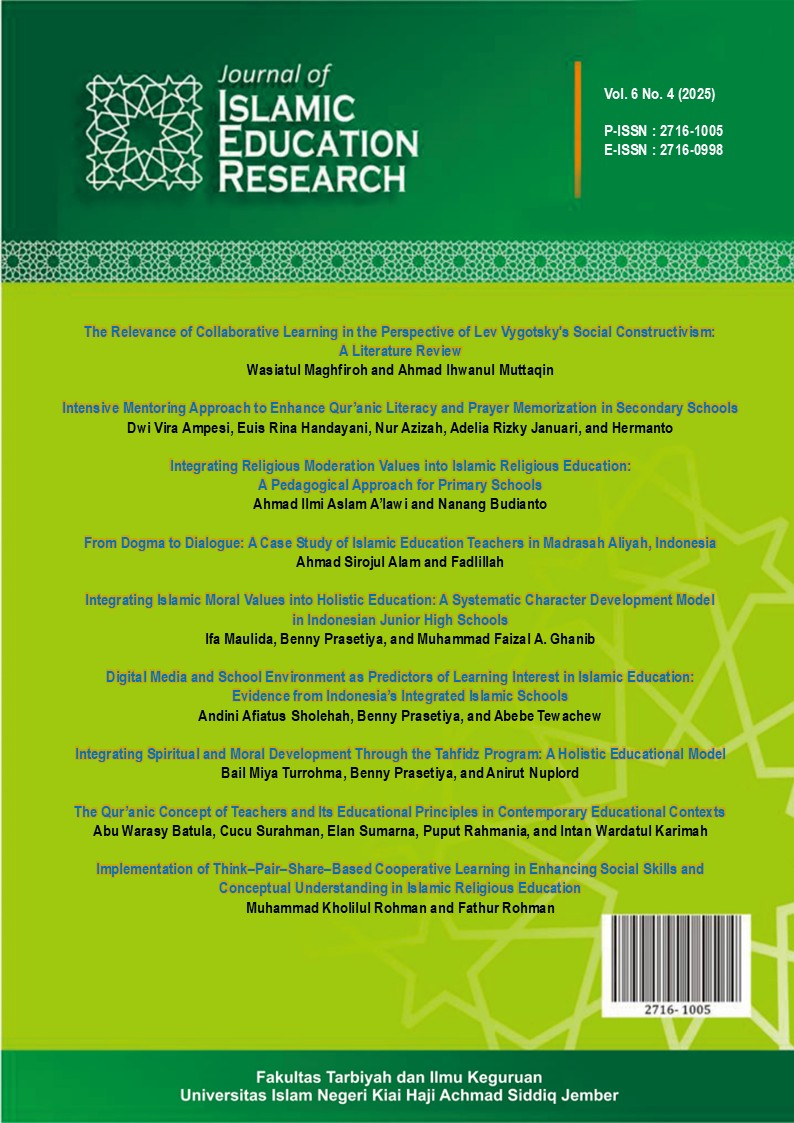
Integrating Spiritual and Moral Development Through the Tahfidz Program: A Holistic Educational Model
This study aims to examine the implementation of the tahfidz program at Al Amri Islamic Boarding School, Probolinggo, as a holistic educational model that integrates spiritual formation, moral cultivation, emotional resilience, and disciplined memorization practices. The research addresses the gap in existing studies that often treat Quran memorization as a cognitive activity without systematically analyzing its multidimensional character-building functions. Employing a qualitative field research design, data were collected through participatory observations, in-depth semi-structured interviews with students, teachers, and administrators, and institutional document analysis. The data were analyzed using reflexive thematic analysis supported by methodological and source triangulation. The findings reveal that structured daily routines, meaning-based memorization, intensive mentoring (riāyah ṭ-ṭullāb), and quality-oriented evaluation significantly enhance memorization stability, emotional regulation, moral awareness, and spiritual depth. Discipline and responsibility gradually shift from external enforcement to internal self-regulation, strengthened by peer mentoring and communal culture. However, academic workload, mental fatigue, and fluctuating motivation remain challenges affecting memorization consistency. The novelty of this study lies in conceptualizing tahfidz as a holistic pedagogical framework that integrates cognitive mastery with spiritual–moral transformation and psychosocial support. This study contributes theoretically by expanding Islamic educational discourse on holistic character formation and practically by offering a structured model for designing sustainable, spiritually grounded tahfidz programs.
Downloads
References
Afkarina, N., & Khadavi, M. J. (2024). Emotional intelligence development of students through Tahfidz program at Al-Amri Islamic Boarding School Probolinggo. International Journal of Islamic Thought and Humanities, 4(2). https://doi.org/10.54298/ijith.v4i2.519
Akmansyah, M., Ramadhani, A., & Prawoto, A. (2024). Integrating spiritual and pedagogical strategies in Tahfidz Al-Qur’an education: A comparative study of two pesantren in Metro City, Lampung. Fikroh, 18(1). https://doi.org/10.37812/fikroh.v18i1.1767
Anirah, A., Naima, N., Retoliah, R., Nursyam, N., & Erniati, E. (2024). Strengthening the disciplinary character education of santri through discipline development in Islamic boarding schools. Qalamuna, 16(1). https://doi.org/10.37680/qalamuna.v16i1.4041
Asrori, M. R., Anam, A. F., Mahmudi, A. I., Ghufron, M., Syafiuddin, M., & Zulfa, I. (2022). Sociocultural activities: Tahfidz Al-Qur’an during COVID-19 pandemic. Advances in Social Science, Education and Humanities Research. https://doi.org/10.2991/assehr.k.220104.041
Ayre, J. (2022). Research note: Thematic analysis in qualitative research. Procedia. https://www.sciencedirect.com/science/article/pii/S1836955321001223
Ayyad, E. (2022). Re-Evaluating Early Memorization of the Qur??n in Medieval Muslim Cultures. Religions, 13(2), 179. https://doi.org/10.3390/rel13020179
Birt, L., Scott, S., Cavers, D., Campbell, C., & Walter, F. (2016). Member checking: A tool to enhance trustworthiness or merely a nod to validation? Qualitative Health Research, 26(13), 1802–1811. https://pubmed.ncbi.nlm.nih.gov/27340178/
Braun, V. (2024). A critical review of the reporting of reflexive thematic analysis. Open Access Journal. https://pmc.ncbi.nlm.nih.gov/articles/PMC11132294/
Byrne, D. (2022). A worked example of Braun and Clarke’s approach to reflexive thematic analysis. Quality & Quantity. https://doi.org/10.1007/s11135-021-01182-y
Gozali, G. (2023). Efektivitas program Tahfidz 30 Juz di SMP Negeri Tahfidz Madani Rokan Hulu Riau. Jurnal Pengabdian Masyarakat dan Penelitian Thawalib, 2(1). https://doi.org/10.54150/thame.v2i1.120
Hennink, M. M., Kaiser, B. N., & Marconi, V. C. (2022). Sample sizes for saturation in qualitative research: A systematic review. Social Science & Medicine. https://www.sciencedirect.com/science/article/pii/S0277953621008558
Hidayat, W., & Hidayat, N. (2023). Islamic boarding school management: A comprehensive analysis of a special program for fostering students’ disciplinary character in Madrasah Ibtidaiyah. Heutagogia, 3(2), 225–236. https://doi.org/10.14421/hjie.2023.32-07
Hidayati, H. (2023). Pengaruh program Tahfidz Al-Qur’an terhadap karakter santri. Hikmah: Jurnal Pendidikan Islam. https://ojs.staituankutambusai.ac.id/index.php/hikmah/article/view/973
Ishomuddin, K., Rizquha, A., & Mubaroq, M. S. (2023). Management Hifdzil Al-Qur’an in improving santri's memorization in Islamic boarding schools. Managere: Indonesian Journal of Educational Management, 5(2). https://doi.org/10.52627/managere.v5i1.214
Jannah, R., Yuzarion, Y., & Purwadi, P. (2022). Hubungan efikasi diri terhadap prokrastinasi pada santri Tahfidz Qur’an. Al-Qalb: Jurnal Psikologi Islam, 13(2), 116–120. https://doi.org/10.15548/alqalb.v13i2.4280
Kallio, H., Pietilä, A.-M., Johnson, M., & Kangasniemi, M. (2016). Systematic methodological review: Developing a framework for a qualitative semi-structured interview guide. Journal of Advanced Nursing, 72(12), 2954–2965. https://doi.org/10.1111/jan.13031
Karimah, F. I. (2023). Peran pengasuh dalam memotivasi menghafal Al-Qur’an terhadap santri Pesantren Ekselensia. Jurnal Iman dan Spiritualitas, 3(2). https://doi.org/10.15575/jis.v3i2.27171
Khoiriyah, H., Hanum, A., & Nahar, S. (2023). Learning Tahfiz Al-Quran at Islamic boarding school. Scaffolding: Jurnal Pendidikan Islam dan Multikulturalisme, 5(1), 919–936. https://doi.org/10.37680/scaffolding.v5i1.2799
McKim, C. A. (2023). Meaningful member-checking: A structured approach to enhance validity in qualitative studies. American Journal of Qualitative Research, 7(2). https://doi.org/10.29333/ajqr/12973
Muchtar, N. E., Ahadiyah, W., Zulianah, E., & Khodijah, S. (2022). The Existence of Prophetic Learning in Improving Spiritual Intelligence Through Tahfidz Al-Qur’an for Students. Nazhruna: Jurnal Pendidikan Islam, 5(3), 1175-1191. https://doi.org/10.31538/nzh.v5i3.2743
Mughni, A.; A. R., Suhardini, A. D., & Afrianti, N. (2022). The analisis manajemen program Kafana di Rumah Tahfidz Khoiru Ummah. Bandung Conference Series Islamic Education, 2(1). https://doi.org/10.29313/bcsied.v2i1.2411
Muttaqin, M. I., Hambali, M., Ismail, A. B., Mulyadi, & Hady, M. S. (2024). Optimizing mental health in Islamic boarding school students: Balancing physical and mental endurance for effective Qur’an memorization. Al-Tanzim, 8(2). https://doi.org/10.33650/al-tanzim.v8i2.8470
Palinkas, L. A., Horwitz, S. M., Green, C. A., Wisdom, J. P., Duan, N., & Hoagwood, K. (2015). Purposeful sampling for qualitative data collection and analysis in mixed method implementation research. Administration and Policy in Mental Health and Mental Health Services Research, 42(5), 533–544. https://pubmed.ncbi.nlm.nih.gov/24193818/
Qi, C., & Yang, N. (2024). Digital resilience and technological stress in adolescents: A mixed-methods study of factors and interventions. Education and Information Technologies, 29(14), 19067-19113. https://doi.org/10.1007/s10639-024-12595-1
Riazi, A. M., et al. (2023). Trustworthiness in L2 writing research: A review and practical guidance. Journal of Second Language Writing. https://doi.org/10.1016/j.rmal.2023.100065
Sabrina, V., Oktavia, G., Albizar, A., Susanti, H., AR, F. M., & Suryani, Y. (2022). Eight supporting factors for students’ success in Quran memorization. Khalifa Journal of Islamic Education, 6(1), 73–82. https://doi.org/10.24036/kjie.v6i1.202
Salim, A., Zailani, & Pohan, S. (2025). Cultivation of character education in the boarding school system: Case study of the Tahfiz Qur’an Islamic Boarding School Tanjung Morawa. Journal of Pendidikan Islam, 7(1). https://doi.org/10.51468/jpi.v7i1.866
Siregar, M. A. H., & Tumiran, T. (2025). The Relevance of the Tahfidz Program in Shaping Students Qur’anic Morality in the Era of Modernization at Islamic Boarding Schools. Al-Fikru: Jurnal Ilmiah, 19(2), 266–279. https://doi.org/10.51672/alfikru.v19i2.737
Villani, D., Sorgente, A., Iannello, P., & Antonietti, A. (2019). The role of spirituality and religiosity in subjective well-being of individuals with different religious status. Frontiers in Psychology, 10, 1525. https://doi.org/10.3389/fpsyg.2019.01525
Wahyuningsih, S., Saepudin, A., & Sanusi, I. (2024). Implementasi program pembinaan Tahfidz melalui metode Tikrar untuk meningkatkan kemampuan menghafal pada santri. Bandung Conference Series Islamic Education, 4(2). https://doi.org/10.29313/bcsied.v4i2.15633
Wijayanti, S. N., & Kurniawan, M. I. (2023). Religious character formation through Quran memorization program. Indonesian Journal of Islamic Studies, 13(1). https://doi.org/10.21070/ijis.v13i1.1798
Yanti, I., Ilmi, D., Zakir, S., Mulia, E., Febrianis, R., & Pilbahri, S. (2023). Pengelolaan program Tahfidz Al-Qur’an di Madrasah Tsanawiyah Negeri (MTsN) 3 Solok. Al-Marsus: Jurnal Manajemen Pendidikan Islam, 1(2). https://doi.org/10.30983/al-marsus.v1i2.7590
Zaenuri, L. A., & Abdullah, S. (2023). Uncovering the Key Elements and Supporting Factors of Tahfiz Houses in Shaping the Spiritual Education of the Younger Generation in Indonesia. FWU Journal of Social Sciences, 17(2). https://doi.org/10.51709/19951272/Summer2023/3
Zakaria, A.R; Karwadi; Budiman, A.M; Fatahillah, M; and Akib, A.R.M. (2025). Strategic Management Practices In Pesantren: Innovations For Enhancing Educational Quality And Organizational Sustainability. MOJEM: Malaysian Online Journal of Educational Management, 13(2), 86-97. https://doi.org/10.22452/mojem.vol13no2.5
Downloads
Section
Copyright (c) 2025 Bail Miya Turrohma, Benny Prasetiya, Anirut Nuplord

This work is licensed under a Creative Commons Attribution-ShareAlike 4.0 International License.