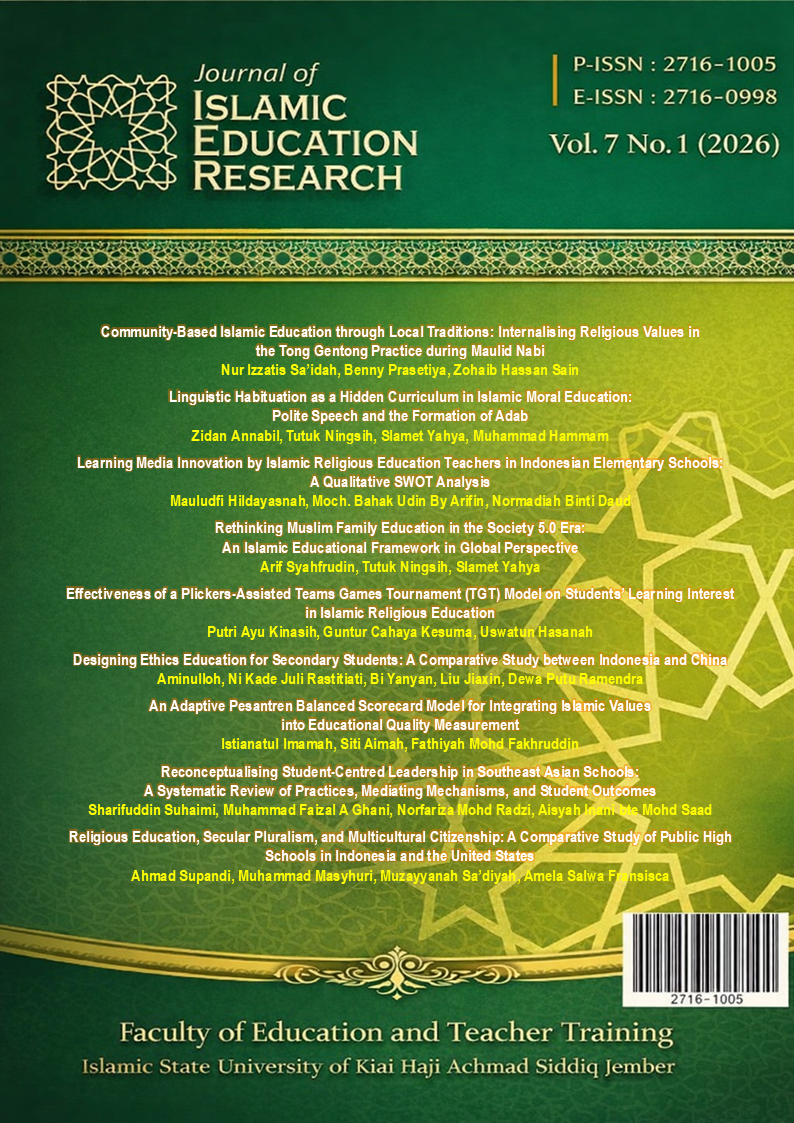
Community-Based Islamic Education through Local Traditions: Internalising Religious Values in the Tong Gentong Practice during Maulid Nabi
This study examines the Tong Gentong tradition during Maulid Nabi in Pohsangit Leres Village, Probolinggo, Indonesia, conceptualising it as community-based Islamic education embedded in local culture. It analyses the internalisation of religious values: “ikhlas” (sincerity), generosity, “syukr” (gratitude), “ukhuwah” (brotherhood), and “ta‘awun” (mutual cooperation) through social practices and elucidates pedagogical mechanism beyond formal institutions. This study employed interpretive qualitative ethnographic case study. Data from participatory observation, in-depth interviews with key community stakeholders, and field documentation were analysed using reflexive thematic analysis to identify value transmission patterns. The findings indicate that Tong Gentong operates as a living pedagogical system where values are internalised through exemplary conduct, habituation, and intergenerational participation rather than through formal instruction. The tradition creates a shared moral space where religious teachings are enacted through collective practices, enabling sustainable character formation within everyday community life. This study reframes local traditions as structured informal Islamic educational mechanisms, offering an empirically grounded model integrating faith, culture and solidarity-enabling communities and educators to leverage such traditions for sustainable religious value internalisation in non-formal curricula. This study expands Islamic education beyond schools by reframing traditions as informal pedagogical systems integrating faith, culture, and solidarity, also offering empirically grounded community-based moral learning model.
Downloads
References
Agung, D. A. G. A., Nasih, A. M., Sumarmi, Idris, & Kurniawan, B. (2024). Local wisdom as a model of interfaith communication in creating religious harmony in Indonesia. Social Sciences & Humanities Open, 9, 100827. https://doi.org/10.1016/j.ssaho.2024.100827
Ahmad, S., Syarifuddin, Umar, Ramadhan, S., & Nazilla, S. (2024). Islamic education for sustaining humanity. IMTIYAZ: Jurnal Ilmu Keislaman, 8(2), 445–457. https://doi.org/10.46773/imtiyaz.v8i2.1035
Al Halib, M. A., & Pusvisasari, L. (2025). Harmony of Islam and Local Traditions in Indonesia: Challenges and Opportunities in the Era of Modernization. Al-Wadhih: Journal of Islamic History and Civilization, 1(1), 20–28. https://doi.org/10.61166/alwadhih.v1i1.4
Al Zahra, U. A. (2024). Social dynamics in the Suroan Tradition: An anthropological study of religious moderation among Javanese Muslims in Kediri. International Journal of Religion and Social Community, 2(2), 19–33. https://doi.org/10.30762/ijoresco.v2i2.3499
Andriyani. (2019). Determinant factors in the formation of students’ Islamic personality at Indonesian School of Bangkok (SIB). Proceedings of the EAI Conference. https://doi.org/10.4108/eai.29-8-2019.2289144
Ardianto, & Hanafie Das, St. W. (2024). The Nature of Culture as the Strength and Stability of Society: The Perspective of Islamic Religious Education. World Journal of Islamic Learning and Teaching, 1(4), 39–50. https://doi.org/10.61132/wjilt.v1i4.143
Arsal, T., Setyowati, D. L., & Hardati, P. (2023). The inheritance of local wisdom for maintaining peace in multicultural society. Journal of Aggression, Conflict and Peace Research, 15(2), 137–151. https://doi.org/10.1108/JACPR-01-2022-0673
Aulia, A., & Yuliyanti, Y. (2024). The strategic role of Islamic education management in integrating Islamic value-based character education in the digital and technology era. IJoIS: Indonesian Journal of Islamic Studies, 5(2), 13–18. https://doi.org/10.59525/ijois.v5i2.548
Braun, V., & Clarke, V. (2021). Thematic Analysis: A Practical Guide. SAGE.
Creswell, J. W., & Poth, C. N. (2018). Qualitative Inquiry and Research Design: Choosing among Five Approaches (4th ed.). SAGE.
Denzin, N. K., & Lincoln, Y. S. (Eds.). (2018). The SAGE Handbook of Qualitative Research (5th ed.). SAGE.
Dewi, S. F., Syafril, Rizki, Hasmira, M. H., Bakhtiar, Y., Salleh, K. M., Yulika, F., Evelynd, & Sulaiman, N. L. (2024). Strengthening social cohesion through the Manyanda tradition in Minangkabau customary society. Journal of Infrastructure, Policy and Development, 8(13), 1–15. https://doi.org/10.24294/jipd9344
Fernando, E., & Yusnan, M. B. B. M. (2022). The tradition of rejectiveness: The character of responsibility in Islamic education values. Jurnal Pendidikan Agama Islam Indonesia, 3(4), 100–105. https://doi.org/10.37251/jpaii.v3i4.945
Fitouchi, L., André, J. B., & Baumard, N. (2023). Moral disciplining: The cognitive and evolutionary foundations of puritanical morality. Behavioral and Brain Sciences, 46, e293. https://doi.org/10.1017/S0140525X22002047
Flick, U. (2018). An Introduction to Qualitative Research (5th ed.). SAGE.
Gorucu, G., & Kitsiou, A. (2025). A Sociological Exploration of Cyber-Islamic Environments of Türkiye. International Journal of Religion & Spirituality in Society, 15(4). https://doi.org/10.18848/2154-8633/CGP/v15i04/197-218
Hasanah, L. U., & Andari, N. (2020). The social and cultural values transmission of an oral tradition. Indonesian Journal of Social Research, 2(3), 196–205. https://doi.org/10.30997/ijsr.v2i3.70
Hudia, T., Supriadi, S., Yolanda, D., Rahmaditha, K., & Alkaf, R. (2023). Islamic Education in the Era of Disruption. GIC Proceeding, 1(1), 237–241. https://doi.org/10.30983/gic.v1i1.172
İnce, M. A., & Tikkanen, J. (2025). Autonomy and Solidarity in School Culture. European Journal of Education, 60(4), e70248. https://doi.org/10.1111/ejed.70248
Jenuri, Faqihuddin, A., Suresman, E., Abdullah, M., & Fahrudin. (2025). Overcoming the spiritual emptiness of students. Cogent Education, 12(1), 2497147. https://doi.org/10.1080/2331186X.2025.2497147
Kallio, H., Pietilä, A. M., Johnson, M., & Kangasniemi, M. (2016). Developing a framework for a qualitative semi-structured interview guide. Journal of Advanced Nursing, 72(12), 2954–2965. https://doi.org/10.1111/jan.13031
Khalid, H., Norfaiza, F., Hasan, A., Rosman, A. S., & Khan, A. (2022). The Integration of Science and Islam in Malaysia of Higher Education Institutes. Journal of Positive School Psychology, 6(3). https://journalppw.com/index.php/jpsp/article/view/1933
Langille-Hoppe, J. N. (2025). Spiritual Practices of Food, Faith, and Place [PhD Thesis]. Texas Christian University.
Michopoulou, E., & Jauniškis, P. (2020). Exploring the relationship between food and spirituality. International Journal of Hospitality Management, 87, 102494. https://doi.org/10.1016/j.ijhm.2020.102494
Miftachurrozaq, T., Suyadi, Bustam, B. M. R., Wantini, & Perawironegoro, D. (2023). Cultural da’wah. Jurnal Dakwah Risalah, 34(2), 129–142. https://doi.org/10.24014/jdr.v34i2.25669
Muqoffa, M., Himawan, K., Juwana, W. E., & Adhi, R. (2024). Multifaceted Role of Construction Materials in Javanese Vernacular Houses. ISVS eJ, 11, 60–95. https://doi.org/10.61275/ISVSej-2024-11-06-05
Muzaki, I. A., Mustofa, T., Ramdhani, K., Abidin, J., & Waluyo, K. E. (2025). Insan kamil at the crossroads of time. Jurnal Ilmiah Pendidikan Islam, 15(1), 219–252. https://doi.org/10.33367/ji.v15i2.7217
Nasir, M. A. (2019). Revisiting the Javanese Muslim slametan. Al-Jami’ah: Journal of Islamic Studies, 57(2), 329–358. https://doi.org/10.14421/ajis.2019.572.329-358
Nordin, O., Abdullah, N. M. S. A. N., & Abdullah, M. R. (2024). Harmonizing Lifelong Learning with Islamic Values. BITARA International Journal of Civilizational Studies and Human Sciences, 7(2), 247–265. https://bitarajournal.com/index.php/bitarajournal/article/view/496
Osman, Y. (2024). Understanding how to develop an effective role-modelling character education programme in Saudi Arabia. Globalisation, Societies and Education, 1–16. https://doi.org/10.1080/14767724.2024.2330363
Pohan, R. A., Ramli, M., Atmoko, A., Akbar, S. D., & Hanurawan, F. (2025). Unveiling gratitude in Javanese Muslim hajatan traditions. Social Sciences & Humanities Open, 11, 101321. https://doi.org/10.1016/j.ssaho.2025.101321
Qasserras, M. (2024). Character and Peacebuilding in Islamic Pedagogy. At-Tadzkir: Islamic Education Journal, 3(1), 26–34. https://doi.org/10.59373/attadzkir.v3i1.50
Ryu, K. (2024). In search of spirituality for intercultural mission. Transformation, 41(4), 304–319. https://doi.org/10.1177/02653788241244541
Saepudin, A. (2024). Holistic Islamic education. International Journal of Science and Society, 6(1), 1072–1083. https://doi.org/10.54783/ijsoc.v6i1.1238
Safitri, S. D. (2024). Strategies for strengthening character education through the integration of Islamic values. Afkarina: Jurnal Pendidikan Agama Islam, 9(1), 18–25. https://doi.org/10.33650/afkarina.v9i1.9395
Sakti, S. A., Endraswara, S., & Rohman, A. (2024). Revitalizing local wisdom within character education through ethnopedagogy approach. Heliyon, 10(10). https://doi.org/10.1016/j.heliyon.2024.e31370
Shevell, M. C., & Denov, M. S. (2021). A multidimensional model of resilience. Child Abuse & Neglect, 119, 105035. https://doi.org/10.1016/j.chiabu.2021.105035
Sholihah, H., & Nurhayati, S. (2022). Prevention of violence against children in school through Islamic parenting styles. Society, 10(2), 627–638. https://doi.org/10.33019/society.v10i2.255
Sumanta, S. (2021). The Values of Perfect Human Beings in the Dignity Seven of Insān Kāmil. Journal of Social Studies Education Research, 12(4), 286–301. https://www.learntechlib.org/p/220447/
Sumarni, W., Junaidi, Devi, I., Simbolon, A. M. Y., & Syafitri, A. (2023). Individual behaviour in Islamic education institutions. GIC Proceeding, 1, 264–271. https://doi.org/10.30983/gic.v1i1.117
Toha, D. W., Puroman, E., & Setiawati, F. (2025). Internalisasi nilai tauhid sebagai pilar pendidikan Islam transformatif. Journal of Education and Social Culture, 1(1), 80–85. https://doi.org/10.58363/jesc.v1i1.19
Williams, L. (2024). Indigenous intergenerational resilience and lifelong learning. Sustainability, 16(11), 4494. https://doi.org/10.3390/su16114494
Xiao, M., Luo, S., & Yang, S. (2025). Synergizing Technology and Tradition. Journal of the Knowledge Economy, 16(1), 1768–1823. https://doi.org/10.1007/s13132-024-01937-6
Yin, R. K. (2018). Case study research and applications: Design and methods (6th ed.). SAGE. https://us.sagepub.com/en-us/nam/case-study-research-and-applications/book250150
Yusoff, M. I. (2025). Islamic Socialization and Civic Engagement. International Journal of Islamic Theology & Civilization, 3(4), 125–167. https://doi.org/10.5281/zenodo.17355806
Zhang, Z., Yu, J., & Tian, J. (2024). Community participation, social capital cultivation and sustainable community renewal. Journal of the Knowledge Economy, 15(3), 11007–11040. https://doi.org/10.1007/s13132-023-01536-x
Zheng, R. (2023). Reconceptualizing solidarity as power from below. Philosophical Studies, 180(3), 893–917. https://doi.org/10.1007/s11098-022-01845-y
Downloads
Section
Copyright (c) 2026 Nur Izzatis Sa’idah, Benny Prasetiya, Zohaib Hassan Sain

This work is licensed under a Creative Commons Attribution-ShareAlike 4.0 International License.